

For organizations with limited budgets, the subject of return on marketing programs is as heavily deliberated as employee hiring. To survive market shifts and meet revenue goals, business owners need marketing solutions that can offer competitive advantages in both speed and efficacy. Let’s compare the benefits and costs of two of the most common online marketing approaches: organic online marketing and paid digital advertising.
Table of Contents
- The Scenario: Private Practice Marketing
- Route 1: Digital Paid Ads Only
- Route 2: Organic Digital Marketing Only
- How Organic Marketing Supports Paid Digital Advertising Efforts
The Scenario: Private Practice Marketing
We’re going to assume the persona of a mental health private practice owner who enlists a digital marketing agency to handle their online promotion efforts.
We’ll also assume the practice has a strict $1,000 monthly marketing budget and earns $160 per hour through private pay clientele alone.
Conversion rate assumptions we’ll use for this exercise:
- 15% Form fill conversion rate. This is the % of people who submit their contact info to access a lead magnet like an ebook or a sign-up for a consult.
- 15% Close rate from paid lead to signed business. This is the % of people who submit a lead form on an ad and convert to closed business.
- 50-70% Close rate from initial consult to signed client. The chances of signing on a client are much higher after they’ve agreed to a consult.
- An average client lifespan of 12 sessions. This is how many sessions the average person agrees for therapeutic services. Each session is billed at the therapist’s hourly rate.
Route 1: Digital Paid Ads Only
In this scenario, let’s assume the private practice owner decided to dedicate their entire $1,000 marketing budget to paid social media ads. When procuring digital marketing ad services, the breakdown would typically look like the following:
- An ad agency will charge a monthly retainer fee (around $200-$300 /month) to manage the ad campaigns, and the remaining budget will be spent on the ads themselves. In this case, the practice owner will spend $700 for the ads.
Effective digital ads should generate leads either in-app (as is the case with LinkedIn document ads), or using a “one-click away” principle. This means the landing page on which there is a form meant to solicit contact information in exchange for the promised online offer should be “one click” away from the ad experience, and not routed to a secondary page.
In our example, let’s use LinkedIn document ads. These ad campaigns, which yield direct leads in-platform, could cost anywhere between $60-$120 per lead, which is very steep, but the campaigns yield hyper-targeted leads with high relevancy, meaning they will match your ideal client profile.
A lead generation form on LinkedIn ads looks like the following.
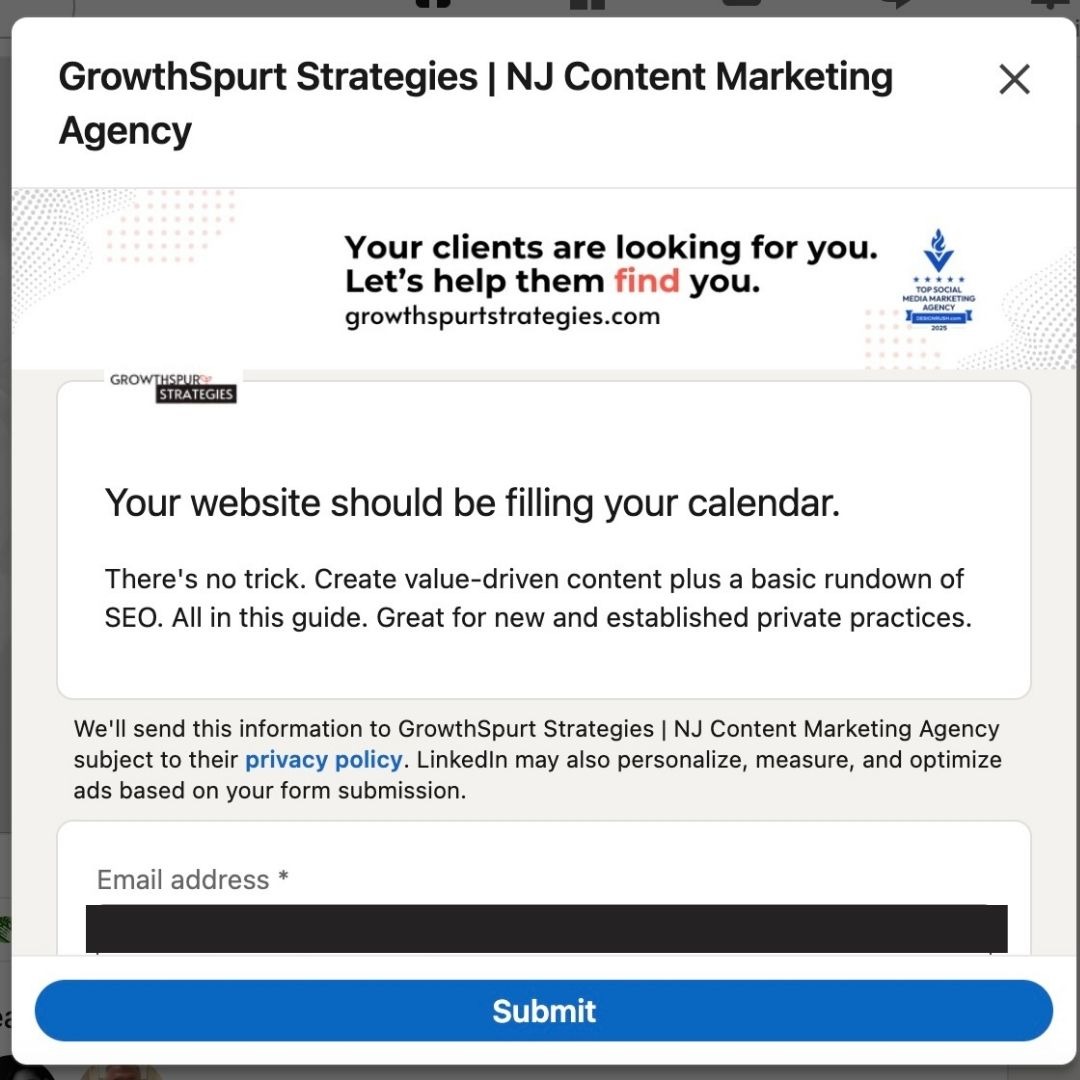
Let’s say this practice owner spends $700 on a lead-generating ad that does well and experiences a 15% form conversion rate, and yields 11 highly-qualified leads at $60 per lead.
Now let’s assume a 15% close rate from lead to closed business. Remember, even though you generated leads from an ad, you still have to nurture them to become consults and then ultimately, booked clients. In this scenario, they yielded 1 new client from 11 very strong leads.
Let’s calculate customer lifetime value. The formula is as follows:
Customer Lifetime Value = (annual revenue per customer – customer acquisition costs) x number of years as a customer.
CLV = ($160 per hour * 12 sessions) * 1 new client – $1,000 total advertising spend. This is $920 profit for 12 total sessions.
Return on investment is calculated as ROI = profit from investment / cost of investment x 100.
This means ROI = $920 / $1,000. ROI for this ad campaign is 92%. This is a positive ROI, but not very high, for one month’s worth of targeted investment.
Before we move onto the organic content marketing scenario, below are a few notes about running paid advertising campaigns:
- Without evidence of success through organic channels like social media engagement, website conversions, or event reaction, it’s not recommended to gamble on paid ads. Using organic channels to test your lead magnets will provide evidence that your ads will bear fruit.
- Paid ads don’t exist in the long term. Digital ads disappear at the end of the campaign timeline. Having a mix of content that exists online in both organic and paid format is the ideal combination. However, this requires financial resources many small business owners don’t have.
- No marketing is effective without an understanding of your value-based messaging and ideal client base. This needs to be confirmed before you spend on either digital ads or organic marketing.
- To run paid digital ad campaigns requires technical skillsets across data analytics and platform proficiency across the many ad platforms in existence. We recommend hiring a paid digital ad specialist rather than attempting to conduct your own ad campaigns.
Now let’s move onto our second approach where the private practice owner engages in organic marketing alone.
Route 2: Organic Digital Marketing Only
We assume in this scenario that the private practice owner maintains the same monthly marketing budget and private pay rate. In addition, we assume the digital marketing agency’s content marketing retainer services cost $450 per month.
By dedicating time to build a robust, SEO-optimized and content driven presence, the private practice will generate high-intention leads and high traffic volume to the practice’s website, therapy listing profiles, and social media profiles.
Let’s assume the following:
- Agency goal of 500 website hits per month. This means the number of people who land on the website from referral sources like social media, YouTube, Reddit, or another website.
- 30% Website engagement rate. This is the number of people who arrive on the website and remain to browse pages or take a desired action.
- 15% Consultation form conversion rate. This is the % of people who submit their contact info for a brief consultation with the therapist.
- 50% Close rate. This is the % of new clients signed from an initial consult
With the goal of 500 monthly visits, the private practice would yield 11 new clients.
Keep in mind, however, that organic content marketing is a longer-term game. It takes on average 6 months to generate a substantial volume of website and social media profile visits. So let’s assume a 6-month investment is necessary. The practice would spend $2,700 in marketing retainer services to generate this volume of new clients.
Let’s calculate CLV again.
CLV = ($160 per hour * 12 sessions ) * 11 new clients – $2,700. This would yield $18,420 in profit across a 6-month timespan. That’s a 682% ROI. Using paid ads alone yielded a 92% ROI. Both are good, but one is an investment in the practice’s future online equity.
When a paid advertising campaign ends, its visuals, copy, and assets are expunged from the internet, and with it, its primary data. Business owners that invest in developing online content engines yield new website visitors, new inquiries, and content downloads well beyond the original campaign timeline.
In our scenario, the private practice owner created a recurring lead pipeline through organic marketing channels without having to spend additional monthly funds. In the case of digital advertising spend, it’s a “pay-to-play” scenario. And as you can observe from our example above, really excellent paid advertising methods require a decent monthly budget to yield enough results to warrant ROI.
When you develop strong organic content marketing engines, you successfully build a lead referral pipeline that exists beyond the partnership of the business and the marketing agency. These efforts maintain a level of self-sufficiency, able to be managed by the business owner on their own.
How Organic Marketing Supports Paid Digital Advertising Efforts
Organic marketing plays a powerful role in the area of primary data accrual. By circulating content offers and your value-based messaging through organic distribution channels, you can accrue direct feedback in the form of comments, downloads, or lack of engagement which can directly inform where, how, and what to use in your paid ad campaigns.
Only after your content warrants earned attention on its own merit, should you back it with digital advertising spend.
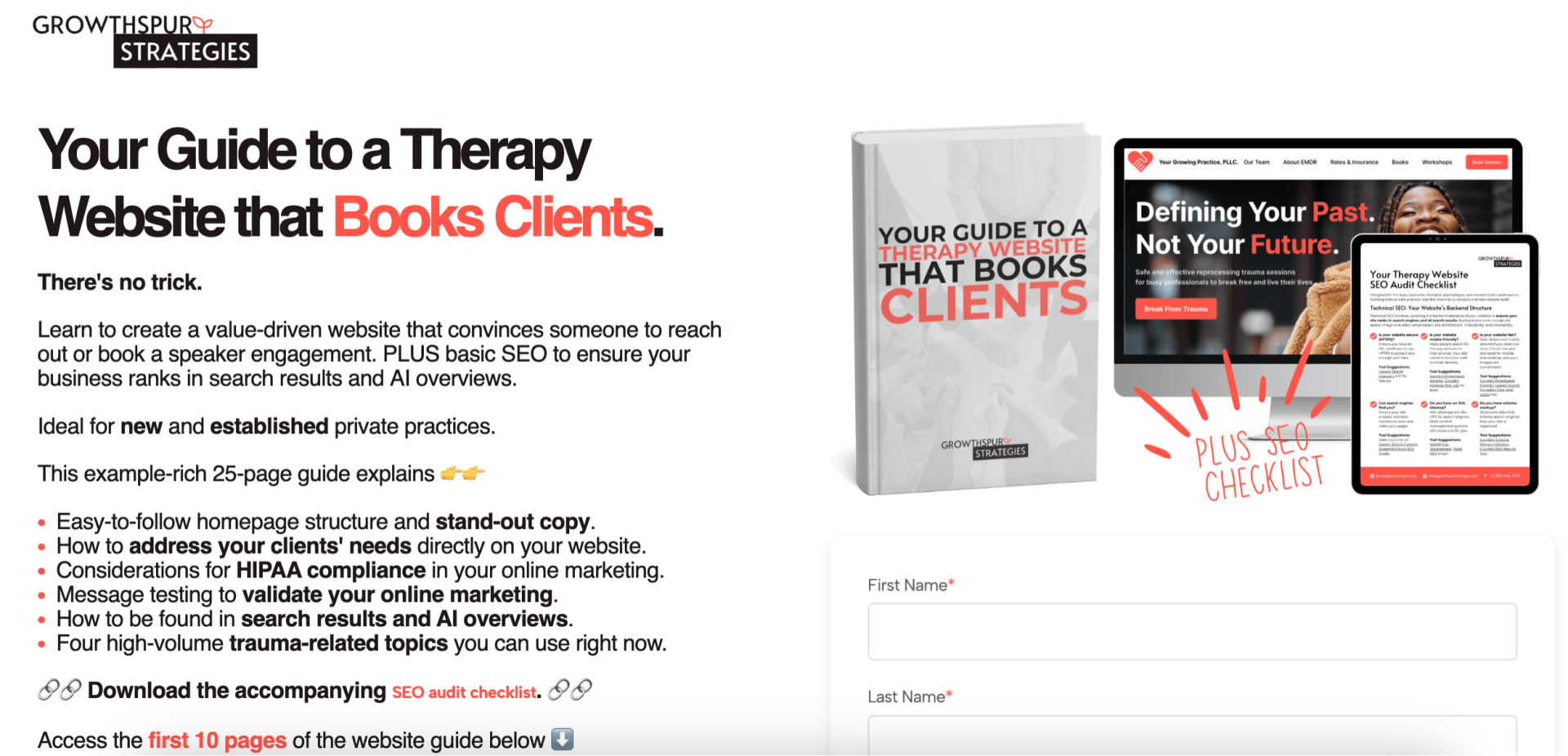
Below is an example of our most popular online ebook, Your Guide to a Therapy Website that Books Clients.
We first validated the concept for this guide through organic social media channels. The solutions and advice included in this ebook stemmed from real conversations with therapists about their persistent website challenges.
Only after validating this concept did we spend the time and money to build the ebook and allocate spend on digital marketing ads. The results included massive spikes in website traffic, broader brand awareness, and substantial new leads.
This content asset continues to yield new leads beyond the initial months of its original marketing campaign.
Scenarios in which we recommend engaging in both paid digital advertising and organic marketing approaches:
- When you need leads quickly and you have an established set of content assets with evidence of success as lead magnets through organic channels.
- When there is a need to “turn off” or “turn on” campaigns for strategic reasons like decreases in demand, or cyclical changes in demand due to seasonal effects.
The journey of marketing your organization in today’s cluttered climate doesn’t have to overwhelm you.
By dedicating your resources to strategic, high-impact marketing, you can build a strong foundation, attract new business, and ensure your value reaches those who need it most.