

If you scroll through social media today, you probably feel as though the only way to promote your private practice is to become an influencer. You may have seen therapists dancing to trendy audio for an Instagram reel or filming themselves in a “day in the life” YouTube short. While this type of content has its place, the growing pressure for mental health professionals to “perform” online often feels invasive and exhausting.
But what if you could build a referral pipeline just by building useful, academically driven, and research-backed content that answers clients’ direct questions, without ever having to point a camera at your face?
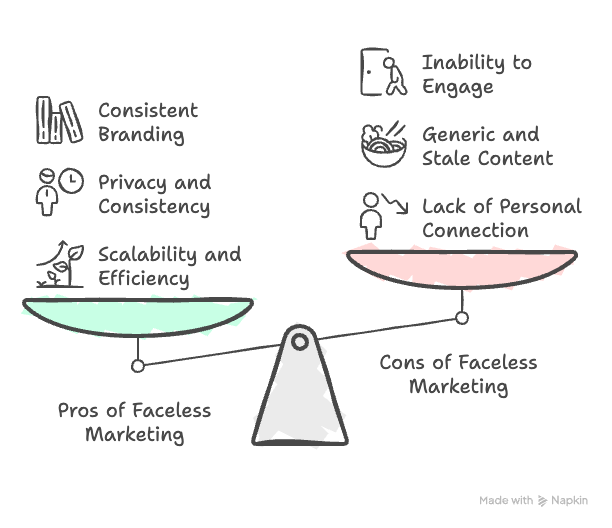
This is what’s known as a faceless digital marketing strategy for mental health professionals. It allows therapists, psychologists, and counselors to build a credible online presence that centers around their expertise to build trust with online audiences, without the need to focus on their personal image.
A strong marketing strategy highlights the value you provide, not your personality. When your value is clearly articulated in a way that preserves your authentic voice, your practice will scale its online presence without requiring constant visibility.
Table of Contents
- Why “Faceless” is the Future of Authentic Marketing
- The Advantage of Niche Faceless Marketing in Mental Health
- How to Create Faceless Digital Marketing Content
- Getting Shared Online: The Consistency Heuristic
- Leveraging Faceless Digital Marketing Across Channels
Why “Faceless” is the Future of Authentic Marketing
Faceless digital marketing is not anonymity. It is the decentralization of one’s physical image within online content. Your goal is to prioritize substance over personal branding, focusing on your message and expertise over your image.
Highlighting Value Over Vanity in Your Online Content
The digital landscape is shifting. According to a June 2025 article by Digiday, brands are allocating more of their influencer budgets toward faceless content creators, in part because these creators emphasize algorithm performance and informational value over followership alone. Audiences gravitate toward content that is visually calm, information dense, and useful, rather than personality driven.
For therapists, this shift in consumer patterns presents an opportunity. By using faceless marketing, your content reframes itself by placing your audience’s healing journey as the central plot, rather than positioning you as the focus.
Increased Authenticity in Your Online Storytelling
Faceless digital marketing can enhance someone’s perceived authenticity of your practice by shifting their attention away from video performance and toward the substance of your content.
When you no longer focus on how you appear on camera, you’re better positioned to give important clinical insight.
From a practical standpoint, this approach removes common worries around lighting, angles, or your on-camera presence. That energy is better invested in creating thoughtful scripts and educational content to support prospective clients online.
The Strategic Advantage of Niche Faceless Marketing in Mental Health
Faceless digital marketing is especially effective for appearing before a clearly defined niche population online.
For example, you may specialize in marriage counseling for pregnant women navigating emotionally distant partnerships, counseling for single mothers working within state agency systems, or EMDR trauma therapy for adolescents.
When your content speaks directly to these distinct experiences, your expertise becomes more valuable precisely because it is difficult to replicate and scarce.
Below is an example of a faceless social media post. The text and image centers around the topic of best practices for getting listed on therapy directories for private practice owners.
The Importance of Experiential Credibility in Faceless Digital Marketing
In the mental health field, credibility is essential. Research shows that audiences often rely on experiential credibility when assessing the trustworthiness of user-generated content. In other words, people are more likely to trust information they see online that reflects firsthand understanding of their lived experience (Metzger & Flanagin, 2015).
When your content captures the emotional realities of a client group, like first responders or women experiencing postpartum depression, your online audience is much more likely to trust your recommendations or follow-up for additonal recommentations.
Always Maintain the Human Factor
A common concern among mental health professionals is that by removing their face from online content, they also remove their authenticity. This assumption is not supported by research.
Studies suggest that audiences are still capable of forming meaningful emotional connections, known as parasocial interactions, even with virtual or artificial influencers, when content reflects “human likeness” (Stein et al., 2022).
If your writing voice is empathetic, grounded, and distinct, and if you incorporate human elements like narration and music, readers can still connect with your message.
Faceless does not mean impersonal; it means the relationship is built through language, insight, and care rather than visual exposure.
How to Create Faceless Digital Marketing Content
So what does this look like in practice? Successful faceless digital marketing can take the form of anonymous blogs, niche educational websites, curated social media accounts, and thoughtfully designed email marketing campaigns.
A Three-Step Approach to High-Quality Content That Engages
To begin, focus on three core areas:
- Create high-quality, valuable content. Your insights should be actionable and grounded in real clinical experience. Avoid chasing trends. The best place to start is by sifting through recurring questions and conversations you have with your clients.
- Optimize for SEO and social search. Ensure your content clearly answers the questions your clients are typing into Google, ChatGPT, Gemini, and major social media platforms.
- Build and own your audience. Relying solely on algorithms puts your practice at risk of online instability. Set aside time every day to intentionally build and nurture your audience for more sustainable reach.
Getting Shared Online: The Consistency Heuristic
Research indicates that people assess credibility through the consistency heuristic, which suggests that individuals are more likely to trust information when they see it validated through repeat exposure and social reinforcement (Metzger & Flanagin, 2015).
For private practice owners, this means you need to ask yourself, “are you leveraging the content you create and the messaging you curate repeatedly over time with an engaged network of contacts online? Or are you promoting your content in simple one-offs, without the encouragement for broader participation over time?”
This is why effective online marketing is not just about publishing content that you forget about later.
Three areas to consider:
- Build your online audience intentionally, recognizing that not all connections are good connections.
- Engage meaningfully through thoughtful comments, questions, and sharing or reposting.
- Create content informed by clear signals from your audience about what they need and value.
Learn how to keep trustworthy in all your online faceless content. Read how in this related article.
Leveraging Faceless Digital Marketing Across Channels
You can leverage both organic marketing and paid marketing channels without ever appearing on camera. Rather than speaking directly to the lens, therapists use B-roll footage, quiet office scenes, hands journaling, or nature imagery paired with educational text overlays.
This approach aligns with emerging consumer trends for 2026, which indicate that while perceived value of a brand may influence someone’s initial choice, their long-term loyalty is driven by how successful your practice is in delivering personalized customer touch points throughout their customer lifecycle (Qualtrics XM Institute, 2026).
So focus on the value your content provides across all your online touch points, and your brand will benefit in the long-term.
Start Scaling Your Practice’s Online Marketing Content
Faceless digital marketing offers an ethical and cost-effective way to share your expertise online while maintaining professional boundaries. So long as you prioritize the human experience and preserve elements of warmth in your content, you can promote your practice in a way that is both profitable and private.
If you’re ready to strengthen your presence online, we can help. We offer options for both new and established private practices.
Visit our pricing page to schedule a no-commitment, 30-minute virtual consultation with our content strategist and GrowthSpurt Strategies owner, Laura Bailey-Wickins, to explore whether a faceless strategy is right for your practice.
Sources
Digiday. (2025). WTF is behind the explosion of faceless creators?https://digiday.com/media/wtf-is-behind-the-explosion-of-faceless-creators/
Metzger, M. J., & Flanagin, A. J. (2015). Psychological approaches to credibility assessment online. In The Handbook of the Psychology of Communication Technology. John Wiley & Sons, Inc. https://flanagin.faculty.comm.ucsb.edu/CV/MetzgerandFlanagin2015(HPCT).pdf
Qualtrics XM Institute. (2026). Consumer Experience Trends Report 2026. https://www.qualtrics.com/ebooks-guides/customer-experience-trends/
Stein, J.-P., Breves, P. L., & Anders, N. (2022). Parasocial interactions with real and virtual influencers: The role of perceived similarity and human-likeness. New Media & Society. https://doi.org/10.1177/14614448221102900