
Deciding to move from accepting health insurance to private pay requires a full understanding of the impact on your marketing and practice viability. This article discusses the broader implications driving mental health professionals away from insurance acceptance and how to reposition yourself to compete within the highly competitive private pay landscape.
Table of Contents
- Economic Implications on Demand
- Considerations of Private Pay
- Analyzing Your Market
- Credentialing vs. Independent
- Independence vs. Dependence
- Changes to the Client Profile
- Perpetual Tradeoffs
According to the American Psychological Association’s 2025 Practitioner Pulse Survey, 62% of mental health professionals accept some form of health insurance. This represents a decline from the 68% reported in the 2024 Pulse Survey results.
Why the decline? Financial hardships, increased living costs, shifting demand, administrative burnout, and insufficient reimbursements drive this shift. According to the 2025 APA Pulse Survey, of the 38% of professionals who no longer accept insurance, 10% noted they stopped doing so within the last year.
Like any major business decision, transitioning your practice requires careful consideration of your marketing and positioning. Promoting mental health services to private pay clients versus insurance clients will impact your online distribution strategy, value-based messaging, and private pay marketing plan.
Please Note: The content in this article is for informational purposes only and does not constitute legal or financial advice. Readers should consult with a lawyer or financial advisor specialized in their field regarding their practices.
Economic Implications on Demand and Private Pay Viability
Following the July 2025 Big Beautiful Bill’s cuts to Medicaid, which accounts for 25% of all U.S. spending on mental health and substance abuse treatments, the trickle-down effect raised premiums, deductibles, and out-of-pocket minimums for private health insurance carriers.
These economic policy changes may have resulted in more cancellations and fewer appointments among clients with private insurance.
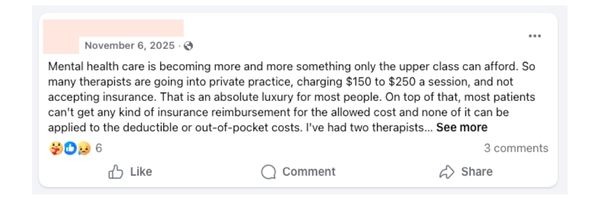
Making the Move Toward Private Pay Marketing: The Considerations
When you stop accepting insurance, you no longer compete on access and copay cost; you compete on value and outcomes. This shift requires a fundamental change in your business operations.
The Strategic Shift in Private Pay Marketing
Transitioning promotion from insurance to private pay means moving from availability-based marketing to specialty-focused, value-based marketing.
Ask yourself, ‘What does demand look like for my specific services, and what percentage of clients procure my services through insurance versus full fee?‘
Insurance clients typically find you by filtering for “Cigna-accepting therapists” in a specific zip code on Psychology Today. However, clients rarely search for “private pay-only therapists” in directories.
How, then, do you show up online?
Private pay marketing requires you to step out from behind the directory curtain. High-value clients search differently. They use high-intention queries on search engines or AI tools like Perplexity, Claude, Gemini, or ChatGPT. They look for answers to specific problems, not just a list of providers.
To capture this traffic, you must niche down to two or three audience segments to test your content and messaging. You cannot be passive. Passivity works when you depend on third-party services like Headway or Alma because they act as an active referral pool. In the private pay world, you must actively search for new clients.
Learn How to Market Your Therapy Private Practice with Funnel-Based Content.
The Market: Analyzing Your Region for Private Practice Success
Before cutting the cord with insurance panels, conduct an analysis of your potential market. Private pay is not viable in every geographic location or for every demographic without a strategy.
Outline your methods, environment, and messaging by asking these questions:
- Do you live in a competitive region? Are services in your specialty easily accessible, or is the market oversaturated? If you are in a high-density area, general therapy will not sell; you need a hyper-specific niche.
- What are your niche areas? What percentage of prospective clients in that niche use insurance versus private pay?
- What is the average household income? Analyze the regions you service. Is there enough disposable income to support a full-fee caseload?
- What are your administrative costs? Calculate exactly what you save in time and billing software fees by moving to private pay.
Credentialing vs. Independent Private Pay Marketing
Many therapists use third-party platforms like Alma, Headway, or Rula to handle credentialing and referrals. While convenient, this approach carries hidden risks.
Therapists report in public forums that insurance companies have rejected their applications for independent credentialing because they were already “credentialed” via these third-party companies. Exclusivity clauses can lock you out of direct billing.
Furthermore, the platform landscape is volatile. For example, Spring Health recently acquired Alma, a move that consolidates power and potentially alters fee structures or referral algorithms.
Monitor these updates closely. Dependence on a single platform is not a long-term success plan. Maintain options, much like diversifying an investment portfolio for security.
Learn the Best Therapy Directories for Private Practice Online Visibility.
If you choose to self-credential to maintain independence, read all insurance company policies on their websites. A common strategy involves credentialing with multiple providers to ensure breadth. However, if you self-credential through only one, you risk your referral pipeline drying up. This is where private pay marketing becomes your safety net.
The Alternative: This is not a problem if you offer private pay only. No insurance clients means no claims billing, no “medical necessity” justifications, and no credentialing headaches.
Independence vs. Dependence in Private Practice
Accepting private pay clients is a strategic move for the survival of your practice. It moves you from dependence to independence.
In the 2025 APA survey, therapists cited insufficient reimbursement as the primary reason for rejecting insurance plans. With private pay, you avoid reimbursement rates that fail to keep pace with inflation. You also avoid insurance carriers denying claims for services you deem critical for treatment.
Changes to Your Client Profile in a Private Pay Model
Peer-reviewed research regarding private practice client behavior, specifically regarding insured versus private pay clients, is scarce.
Therefore, the following observations derive from online forums and direct conversations with U.S. therapists. Note that these observations may not apply to every practice.
However, the consensus among many private practitioners suggests:
- Higher Investment: Acquiring private pay clients is difficult, but often worth the effort. These clients typically remain in treatment longer and are more psychologically invested in the process.
- Fewer Cancellations: Clients paying full fees out-of-pocket are less likely to cancel late than those with low copays.
- Willingness to Spend: Because they are less price-conscious regarding their health, these clients are often willing to pay for additional services or intensive workshops.
Perpetual Tradeoffs of Private Pay Marketing
Moving to private pay is not a magic bullet. It is a trade-off.
Insurance Model:
- Easier client acquisition (via insurance portals or third-party platforms).
- Lower revenue per session.
- Higher administrative burnout.
Private Pay Model:
- Harder client acquisition (requires active private pay marketing).
- Significantly higher revenue per session.
- Treatment autonomy and lower administrative costs.
Many therapists choose a “hybrid” mix which means partial insurance, partial private pay. This is a smart move if you are dipping your toe into the private pay waters, allowing you to build your marketing engine while maintaining a baseline of referrals.